




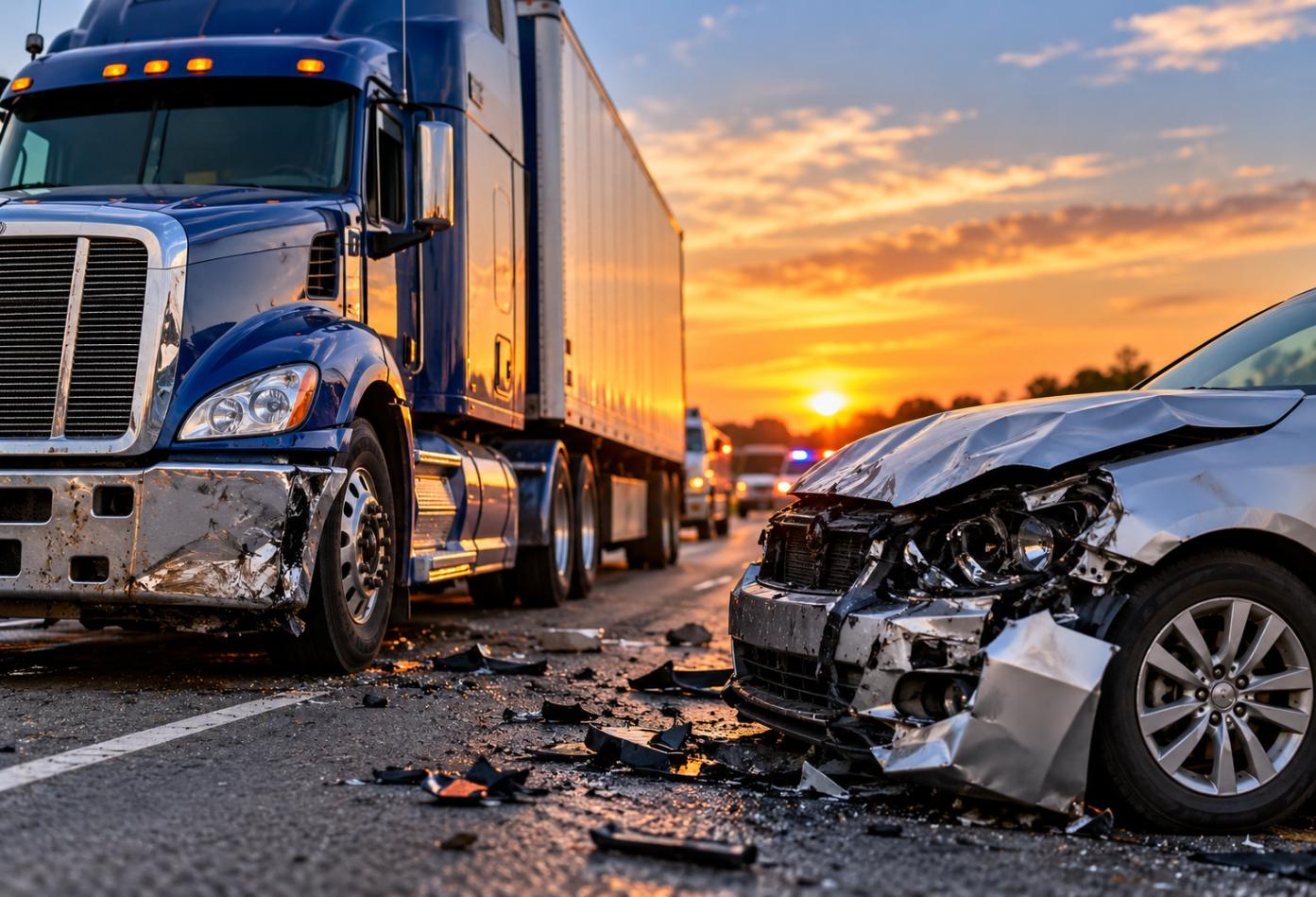
A crash on I-2 near McAllen or Pharr can become much more complicated when an 18-wheeler or commercial truck is involved. In the Rio Grande Valley, major freight routes, international trade, and everyday passenger traffic regularly share the same highways, making it useful for local drivers to understand how truck accident claims differ from ordinary car accident claims.
Quick answer: Truck accident claims in Texas can differ from car accident claims because commercial vehicle cases may involve trucking companies and other parties, commercial records, federal safety regulations, and Texas laws specifically addressing commercial motor vehicle lawsuits. A typical two-car collision may focus primarily on the conduct of the drivers, while a truck crash can require investigation of the driver, carrier, vehicle, maintenance, and other evidence.
What Rio Grande Valley drivers should know
- A commercial truck claim may involve both the truck driver and a company responsible for the vehicle or driver.
- Federal trucking regulations can create additional sources of evidence that are not usually central to an ordinary passenger-car claim.
- The Rio Grande Valley has significant freight activity along corridors including I-2, I-69C, I-69E, US 281, and US 77.
- Evidence held by a trucking company may become important when determining how and why a collision occurred.
- Texas has statutory provisions specifically governing certain civil actions involving commercial motor vehicles.
Why Are Truck Accident Claims Different From Car Accident Claims in Texas?
Truck accident claims are different from many car accident claims because they can involve commercial operators, employers, specialized records, federal regulations, and Texas laws governing commercial motor vehicle litigation. Those additional layers can make identifying responsible parties and gathering evidence more involved than in a typical collision between two passenger vehicles.
That distinction is especially relevant in the Rio Grande Valley. Texas Department of Transportation freight planning materials identify major regional freight corridors such as I-2, I-69C, I-69E, US 281, and routes serving international bridges and trade hubs.
Drivers around McAllen, Pharr, Edinburg, Weslaco, Harlingen, and Brownsville may therefore share roads with tractor-trailers, delivery trucks, and other commercial vehicles as part of normal regional traffic.
Rivas Law Firm, PLLC serves people dealing with personal injury matters in the Rio Grande Valley. After the first conversation about a crash, we can examine the circumstances and determine which legal and factual issues may need further investigation.
What Evidence Can Matter in a Texas Truck Accident Claim?
Evidence in a Texas truck accident claim can extend beyond photographs, police information, medical records, and witness accounts to include records associated with the commercial vehicle and its operation. Exactly which records matter depends on the vehicle, carrier, circumstances of the collision, and legal issues involved.
For an ordinary car accident, evidence often centers on questions such as which driver failed to yield, followed too closely, changed lanes unsafely, or otherwise contributed to the crash.
Commercial truck cases may require a broader investigation. Depending on the facts, potentially relevant information could concern the truck’s operation, maintenance, driver, employer, or other parties connected to the vehicle.
Preserving available evidence can be particularly important after a serious collision. Photos of the vehicles and roadway, witness information, medical documentation, and records relating to the crash can help establish what occurred.
How Does Truck Traffic Affect Accident Claims in the Rio Grande Valley?
Truck traffic affects Rio Grande Valley accident claims by placing commercial vehicles on some of the same major corridors residents use for commuting, shopping, school, and regional travel. TxDOT’s Rio Grande Valley Freight and Trade Transportation Plan documents commercial vehicle activity throughout the region and identifies truck-involved crashes across the study area.
The regional transportation network also connects communities with international ports of entry and major trade routes. Freight planning documents identify I-2 and I-69C as significant corridors associated with regional movement and access to the Pharr-Reynosa International Bridge.
That does not mean every collision on a freight corridor is caused by a commercial vehicle. It does mean that identifying the type of truck, its operator, and the entities connected to it can be an important early step after a local crash.
Who May Be Involved in a Commercial Truck Accident Claim?
A commercial truck accident claim may involve parties beyond the individual driver, depending on who owned, leased, controlled, operated, or maintained the vehicle and what caused the collision. Determining potential responsibility requires examining the facts rather than assuming that every trucking case involves the same defendants.
Texas Civil Practice and Remedies Code Chapter 72 contains specific provisions for certain civil actions involving commercial motor vehicles. The statute defines covered actions in part by reference to defendants who operated, owned, leased, or otherwise exercised legal control over a commercial motor vehicle or its operator.
For a Rio Grande Valley resident, this can make the investigation different from a collision involving two privately owned passenger vehicles.
What Warning Signs Suggest a Truck Accident Claim May Be More Complex?
A truck accident claim may require additional investigation when commercial ownership, serious injuries, disputed responsibility, multiple entities, or specialized vehicle records are involved. Recognizing those issues early can help an injured person understand why treating the crash like a routine insurance matter may overlook relevant evidence.
Potential signs of added complexity include:
- The vehicle was an 18-wheeler, tractor-trailer, delivery truck, or another commercial vehicle.
- The driver was working when the collision happened.
- A trucking or transportation company owned or controlled the vehicle.
- Several vehicles were involved in the collision.
- Responsibility for the crash is disputed.
- The collision caused substantial injuries or required ongoing medical treatment.
- Questions exist about the truck’s condition or maintenance.
- The crash happened on a major commercial corridor such as I-2, I-69C, or I-69E.
When Should You Contact a Lawyer After a Truck Accident?
You should consider contacting a lawyer promptly when a commercial truck crash causes injuries, involves disputed responsibility, or raises questions about a trucking company’s records or conduct. Early legal review can help identify potentially relevant evidence and determine which individuals or businesses may need to be investigated.
There are still practical steps accident victims can take themselves. Keep photographs and videos, save medical paperwork, retain insurance correspondence, and write down what you remember about the collision while the details are fresh.
Legal questions become more significant when responsibility is unclear, injuries are serious, or commercial parties are involved. These situations can require analysis beyond what a driver can determine from the crash scene alone.
What Are Common Causes Investigated After Rio Grande Valley Truck Crashes?
Common issues investigated after Rio Grande Valley truck crashes can include driver actions, following distance, lane changes, vehicle condition, maintenance, and other circumstances surrounding the commercial vehicle’s operation. The cause cannot be determined from the size of the truck or location of the crash alone, so evidence from the individual collision matters.
Local roadway conditions can also shape the investigation. Traffic moving between McAllen and Harlingen on I-2 differs from traffic approaching international trade crossings or traveling along I-69C through the Pharr and Edinburg area.
Investigators may therefore consider roadway configuration, surrounding traffic, vehicle movements, visibility, and the commercial vehicle’s role immediately before the impact.
What Should You Do After a Truck Accident in the Rio Grande Valley?
After a truck accident in the Rio Grande Valley, prioritize medical needs and safety, document the scene when it is safe to do so, exchange necessary information, and preserve records related to the collision. A commercial vehicle crash may create evidence issues that differ from those arising after a routine car accident.
Useful steps can include:
- Seek appropriate medical attention for injuries.
- Photograph vehicle damage and the surrounding roadway if you can safely do so.
- Preserve information identifying the commercial vehicle and company.
- Collect contact information from available witnesses.
- Keep medical bills, treatment records, and accident-related correspondence.
- Avoid guessing about fault when discussing a crash you have not fully investigated.
- Consider obtaining legal guidance when injuries or commercial parties make the claim more complicated.
How Does Texas Fault Law Apply to Truck and Car Accidents?
Texas proportionate responsibility rules can apply to negligence claims arising from both truck and car accidents, and an injured claimant’s assigned percentage of responsibility can affect recovery. Under Texas Civil Practice and Remedies Code Chapter 33, a claimant generally cannot recover damages when the claimant’s percentage of responsibility is greater than 50 percent.
If the claimant is not barred from recovery, the statute provides for recoverable damages to be reduced according to the claimant’s percentage of responsibility.
This makes evidence important in both types of cases. Whether a crash occurs on a surface street in McAllen or a major corridor elsewhere in Hidalgo County, disputed accounts of how the collision happened can affect the legal analysis.
What Results Can You Expect From a Truck Accident Investigation?
A truck accident investigation can provide a clearer picture of how the collision occurred, which parties may bear responsibility, what evidence supports the claim, and what losses need to be documented. It does not guarantee a particular settlement or court result because every case depends on its evidence and applicable law.
The investigation may also clarify whether the case is primarily about the truck driver’s actions or whether issues involving a commercial entity require examination.
For injured Rio Grande Valley residents, that distinction can help determine what information should be preserved and which parties may need to be contacted as a claim develops.
What Mistakes Can Hurt a Truck Accident Claim?
Common mistakes after a truck accident include failing to preserve evidence, delaying necessary medical care, assuming the truck driver is the only potentially responsible party, or treating a commercial crash exactly like a minor car accident. A better approach is to document the collision carefully and evaluate its specific facts.
Mistake: Losing photos, correspondence, or other accident information.
Consequence: Potentially useful evidence may become harder to locate later.
Better approach: Organize and preserve records connected to the collision.
Mistake: Assuming every relevant issue appears in the police crash report.
Consequence: Commercial records or other evidence may go unexplored.
Better approach: Consider the broader circumstances surrounding the vehicle and its operation.
Mistake: Assuming fault simply because a large truck was involved.
Consequence: The claim may be based on an incomplete understanding of what occurred.
Better approach: Evaluate the evidence before reaching conclusions about responsibility.
What Is a Common Rio Grande Valley Truck Accident Scenario?
A common Rio Grande Valley scenario involves a passenger vehicle and commercial truck colliding while traveling on or entering a busy freight corridor such as I-2 or I-69C. This is an illustrative scenario, not a Rivas Law Firm, PLLC case result or client story.
After such a collision, the passenger-vehicle driver may initially have only information visible at the scene. Further investigation could be needed to establish who owned or controlled the commercial vehicle, whether the driver was working, and what additional records may be relevant.
That additional layer illustrates why a truck accident claim can develop differently from a standard two-car insurance claim.
What Legal Services Can Help After a Commercial Vehicle Crash?
Legal services after a commercial vehicle crash can include investigating responsibility, preserving and reviewing evidence, identifying potentially responsible parties, documenting damages, communicating about the claim, and evaluating applicable Texas law. The exact work required depends on the circumstances of the collision.
For someone injured in McAllen, Pharr, Edinburg, or another Rio Grande Valley community, the first step is understanding whether the collision presents issues beyond those found in a typical passenger-car claim.
How Do Truck Accident and Car Accident Claims Compare?
Truck and car accident claims share core issues such as negligence, causation, injuries, damages, and insurance, but truck claims can add commercial parties, specialized records, and laws specifically addressing commercial motor vehicle cases. The correct approach depends on the vehicles and facts involved.
| Issue | Car Accident Claim | Truck Accident Claim |
|---|---|---|
| Potential parties | Often individual drivers and vehicle owners | May include driver and commercial entities |
| Evidence | Photos, witnesses, medical records, vehicle damage, crash information | May include those items plus relevant commercial records |
| Regulations | Primarily state traffic and liability law | State law plus potentially applicable commercial trucking regulations |
| Investigation | Often focused on driver conduct | May require investigation of driver and company-related issues |
| Texas commercial vehicle statutes | Usually not central | May directly affect litigation involving qualifying commercial vehicles |
Where Do Rio Grande Valley Truck Accident Claims Commonly Arise?
Rio Grande Valley truck accident claims can arise throughout Hidalgo and Cameron counties, including areas around McAllen, Pharr, Edinburg, Weslaco, Harlingen, and Brownsville. Major corridors such as I-2, I-69C, I-69E, US 281, and US 77 help connect these communities with regional and international freight movement.
What Can Happen If You Wait to Investigate a Truck Accident?
Waiting to investigate a truck accident can make it more difficult to locate witnesses, preserve available evidence, reconstruct the collision, and identify information relevant to a commercial vehicle or company. The practical concern is preservation and documentation, not creating unnecessary fear or assuming that evidence will disappear in every case.
Texas also imposes legal deadlines on civil claims, and the applicable deadline can depend on the particular cause of action and circumstances. Anyone unsure about a deadline should obtain advice based on the specific facts rather than relying on a general online timeline.
FAQ About Truck Accident vs. Car Accident Claims in Texas
Is a truck accident claim different from a car accident claim in Texas?
Yes. A Texas truck accident claim can involve commercial entities, specialized records, and laws governing commercial motor vehicle litigation in addition to the negligence and damages issues found in ordinary car accident claims. The precise differences depend on the truck, driver, company relationship, and circumstances surrounding the collision.
Can a trucking company be involved in a Rio Grande Valley accident claim?
Yes, a trucking company may be relevant depending on its relationship to the driver and commercial vehicle and the facts causing the crash. Texas law specifically addresses certain claims involving commercial motor vehicles and employer defendants, so responsibility should be evaluated from evidence rather than assumed from vehicle ownership alone.
Why are there so many commercial trucks on Rio Grande Valley highways?
The Rio Grande Valley contains important regional and international freight routes. TxDOT freight planning identifies corridors including I-2, I-69C, I-69E, US 281, and US 77 as part of the region’s freight network, connecting communities and commercial traffic with trade crossings and other transportation infrastructure.
Are truck accidents around Pharr handled differently from regular car accidents?
A commercial truck accident around Pharr may present additional legal and evidentiary issues compared with a passenger-car collision. The Pharr area is connected to significant freight routes, including I-2 and I-69C. The actual claim process, however, depends on the vehicles, parties, injuries, insurance, and evidence involved.
Does Texas use comparative fault in truck accident cases?
Texas uses a proportionate responsibility system for covered negligence claims. A claimant generally cannot recover damages if that person’s percentage of responsibility is greater than 50 percent. If recovery is permitted, the amount can be reduced based on the claimant’s assigned percentage of responsibility.
What evidence should I keep after a truck crash in McAllen or Edinburg?
Keep photographs, videos, witness information, medical paperwork, insurance communications, vehicle information, and any documentation identifying the commercial truck or company. Evidence needs vary by collision, but preserving what you already possess can make it easier to understand the circumstances if the claim later requires additional investigation.
Do federal trucking regulations matter after a Texas truck accident?
They can. Depending on the type of commercial vehicle and operation involved, federal motor carrier safety requirements may be relevant to an investigation. Not every regulation applies to every truck or every crash, so the vehicle, carrier, trip, and specific facts must be examined before determining which rules matter.
Can I handle a Rio Grande Valley truck accident claim myself?
You can personally preserve records, document the crash, obtain medical care, and communicate basic information, but commercial vehicle claims may raise issues that are difficult to evaluate without legal assistance. Serious injuries, disputed fault, multiple parties, or questions involving trucking-company evidence are reasons to consider professional legal guidance.
Get Answers About Your Rio Grande Valley Truck Accident
A commercial vehicle collision can raise questions that do not appear in an ordinary car accident claim. We can help you understand the parties, evidence, and Texas legal issues that may apply to your specific situation.