




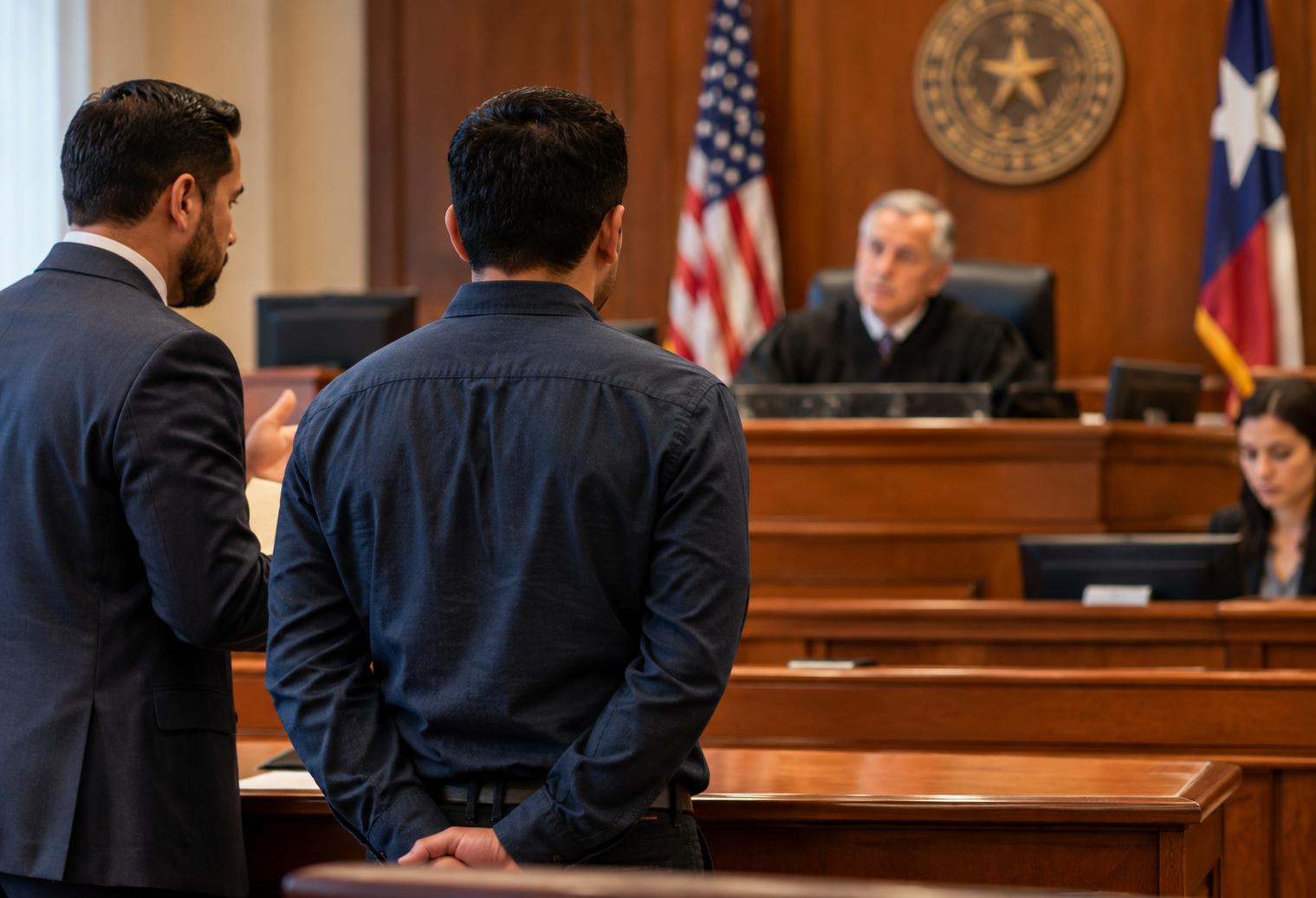
After a DWI arrest in Pharr or elsewhere in Hidalgo County, receiving notice of an arraignment can make the case suddenly feel much more serious. You may know when and where to appear but still have questions about what the judge will ask, whether you need to enter a plea, and what happens after you leave the courtroom.
A DWI arraignment is an early court proceeding that formally addresses the pending charge and the defendant’s plea. Under the Texas Code of Criminal Procedure, an arraignment is required in misdemeanor cases punishable by imprisonment, and its stated purpose is to establish the defendant’s identity and hear the defendant’s plea. Because a standard DWI under Texas Penal Code Section 49.04 is generally a Class B misdemeanor punishable by possible confinement, arraignment is part of the court process in these cases.
What Hidalgo County defendants should know
- An arraignment is not the same thing as a DWI trial, and witnesses generally are not being presented to decide guilt or innocence at this stage.
- Hidalgo County has multiple County Courts at Law in Edinburg that handle misdemeanor criminal matters, so defendants should confirm the specific court listed in their case information rather than assuming where they need to appear.
- A plea is addressed during arraignment, making it important to understand the legal consequences before responding in court.
- Hidalgo County courts can have court-specific procedures concerning DWI arraignment waivers, so defendants should not assume that procedures used by another court will apply to their case. For example, County Court at Law No. 9 publishes a specific requirement for DWI arraignment waivers.
- A DWI criminal case and driver’s license issues can involve different procedures and deadlines. The arraignment should not be treated as the only matter requiring attention after an arrest.
For residents of Pharr, McAllen, San Juan, Alamo, Mission, Edinburg, and surrounding communities, the courthouse handling the criminal case may be in Edinburg even though the arrest occurred somewhere else in Hidalgo County. The county courthouse is located on North Closner Boulevard in Edinburg, and several County Courts at Law operate at that location.
Rivas Law Firm, PLLC. serves clients from Pharr, Texas. When we help someone facing a DWI charge, understanding what happened before the court date and what comes next can be just as important as preparing for the arraignment itself.
What Is a DWI Arraignment in Hidalgo County?
A DWI arraignment in Hidalgo County is a court proceeding used to establish the defendant’s identity and hear a plea in the pending criminal case. Texas law specifically identifies those as the purposes of arraignment, and misdemeanor offenses carrying possible imprisonment require an arraignment.
For a typical first DWI charged under Texas Penal Code Section 49.04, the offense is generally a Class B misdemeanor. Texas law provides exceptions and enhancements that can change the classification depending on the circumstances, including a reported alcohol concentration of 0.15 or higher and certain other factors.
That means two people arrested for DWI in the Rio Grande Valley should not assume that their cases will proceed identically. The exact charge, prior history, alleged facts, bond conditions, and court assignment can affect what happens.
What Happens When You Arrive for Arraignment?
At a DWI arraignment, the court addresses the pending charge, confirms the defendant’s identity, and handles the plea required at this stage of the case. The proceeding is an early step in the prosecution rather than a trial on whether the State can ultimately prove the allegation.
Before going to court, check the notice or case information carefully for the assigned court, date, time, and appearance requirements. Hidalgo County operates several County Courts at Law, and procedures can differ between individual courts.
For example, County Court at Law No. 6 states that its hearings are conducted in person and directs people to contact the court for specific procedures. County Courts at Law Nos. 9 and 10 publish DWI-related waiver information on their county webpages.
Because procedures can change, information from a friend whose DWI case was handled in another Hidalgo County court should not substitute for instructions applicable to your assigned court.
Will You Have to Enter a Plea at the Arraignment?
A plea is part of the arraignment process because Texas law defines arraignment as a proceeding for establishing identity and hearing the defendant’s plea. The appropriate plea and how it is entered should be considered in light of the particular charge and defense strategy.
For misdemeanor cases, Texas law contains procedures governing guilty and no-contest pleas. A DWI defendant should understand the consequences before making decisions about a plea simply because the court appearance seems routine.
An arraignment also should not be confused with a final determination of the case. A DWI prosecution can continue through evidence review, motions, negotiations, hearings, and potentially trial after this early proceeding.
Can a DWI Arraignment Be Waived in Hidalgo County?
Texas law allows an attorney representing a defendant to present a waiver of arraignment, but Hidalgo County DWI cases can be subject to additional court-specific procedures. Defendants should therefore confirm the rules of the particular County Court at Law handling the case rather than assuming an appearance can be skipped.
The local distinction matters. Hidalgo County Court at Law No. 9 states that it accepts waivers of arraignment for DWI cases only when proof of an alcohol monitoring device is attached to the waiver. County Court at Law No. 10 also publishes a specific DWI waiver form and information concerning alcohol-monitoring devices.
Those examples show why local court procedure matters. A defendant should never miss a scheduled appearance based only on the general fact that Texas law permits arraignment waivers.
What Should You Bring to a DWI Arraignment?
For a DWI arraignment in Hidalgo County, bring the court paperwork available to you and any information your attorney has specifically requested. Your attorney or assigned court can tell you whether additional documents are required for your particular appearance.
Useful materials may include your court notice, bond paperwork, charging documents you have received, and records related to any conditions imposed following the arrest.
If an ignition interlock, portable alcohol monitor, or another release condition applies, keep documentation concerning compliance available for your attorney. This can be especially relevant because some Hidalgo County courts expressly reference alcohol-monitoring documentation in connection with DWI arraignment procedures.
What Issues Should You Discuss With a Lawyer Before Arraignment?
Before a DWI arraignment, defendants should discuss the charge, evidence, release conditions, driving privileges, and upcoming deadlines with counsel. The arraignment itself may be brief, but the decisions surrounding the early stages of a DWI case can affect how the defense proceeds.
Issues worth reviewing include:
- The stated reason for the traffic stop or initial police contact.
- Field sobriety testing and how it was administered.
- Whether breath or blood testing occurred.
- Video from the roadside, patrol vehicle, or booking process.
- The exact DWI charge and whether an enhancement has been alleged.
- Existing bond or alcohol-monitoring conditions.
- Driver’s license issues arising from the arrest.
- Future court settings and deadlines.
For someone arrested after a stop in Pharr, McAllen, Mission, Edinburg, or another Hidalgo County community, reviewing these details early can help separate the arraignment itself from the larger defense issues in the case.
What Are Common Mistakes Before a Hidalgo County DWI Arraignment?
Common mistakes before a Hidalgo County DWI arraignment include ignoring court instructions, assuming another defendant’s experience will apply to your case, and treating the hearing as the only deadline that matters after an arrest.
Mistake: Missing the court date.
The consequence can be additional problems with the pending case. The better approach is to verify the assigned court, date, time, and appearance requirements in advance.
Mistake: Assuming the arraignment is the trial.
This can cause unnecessary confusion about what must happen at the first appearance. The better approach is to understand that arraignment addresses identity and plea, while litigation over the evidence can occur later.
Mistake: Assuming a waiver automatically means you can stay home.
Hidalgo County courts can maintain specific DWI waiver procedures. The better approach is to obtain confirmation from counsel or the assigned court before missing any required appearance.
Mistake: Ignoring release conditions.
A court appearance does not erase existing bond or monitoring requirements. Continue following all applicable court orders unless the court changes them.
Mistake: Waiting to examine the evidence.
The better approach is to begin identifying reports, recordings, testing information, and other evidence relevant to the DWI allegation as the case moves forward.
What Happens After a DWI Arraignment?
After a DWI arraignment, the criminal case normally remains pending unless it is resolved through an applicable legal procedure. The defense can then continue reviewing evidence, identifying legal issues, addressing motions, discussing possible resolutions, and preparing for later court settings or trial when necessary.
The specific sequence depends on the assigned Hidalgo County court and the circumstances of the charge. A routine misdemeanor DWI can follow a different path from a case involving an enhanced allegation or additional criminal charges.
The important point for local defendants is that arraignment is a stage of the case, not necessarily the end of it.
When Should You Contact a DWI Attorney?
A person facing a DWI charge should consider contacting an attorney early enough to review court requirements and time-sensitive issues before important decisions are made. Waiting until the arraignment date can leave less time to understand the allegations, release conditions, evidence, and separate driver’s license concerns.
For defendants in Pharr and throughout Hidalgo County, early preparation can also help determine which local court is handling the case and whether that court has specific procedures affecting the arraignment.
Common Local Scenario
A common Hidalgo County DWI scenario begins with an arrest in Pharr or a neighboring community, followed by release from custody and paperwork directing the defendant to future court proceedings. The defendant may then learn that the misdemeanor case is assigned to a County Court at Law in Edinburg.
At that point, the person may have several concerns at once: complying with release conditions, determining whether driving privileges are affected, preparing for arraignment, and understanding what evidence exists.
The key is not to treat all of those issues as one deadline. The criminal court process and other consequences connected with the arrest may operate under different procedures.
How Can a DWI Defense Lawyer Help With the Arraignment Process?
A DWI defense lawyer can help a defendant understand the charge, determine the applicable court procedure, address the arraignment, and begin evaluating the evidence underlying the prosecution. Representation also gives the defendant someone who can track the criminal case beyond the first appearance.
Our work can include reviewing the circumstances surrounding the stop and arrest, identifying available evidence, explaining court settings, evaluating alleged test results, and determining which legal issues warrant further investigation.
The goal at this stage is not to make assumptions about the outcome. It is to understand the case, comply with court requirements, and prepare for the proceedings ahead.
How Do Your Options Compare Before Arraignment?
Handling an arraignment without first understanding the case can leave important questions unanswered, while obtaining legal guidance beforehand can provide a clearer picture of the charge and local procedure.
Someone representing themselves must personally keep track of court requirements, filings, deadlines, and the implications of decisions made during the case. Someone represented by counsel can obtain advice based on the specific charge, court, evidence, and procedural posture.
Texas law also specifically permits an attorney representing a defendant to present a waiver of arraignment. Whether a waiver is appropriate or accepted in a particular Hidalgo County DWI case depends on the applicable procedure.
Where Are Hidalgo County DWI Cases Handled?
Misdemeanor criminal matters in Hidalgo County can be handled by the county’s Courts at Law, many of which are located at the Hidalgo County Courthouse complex at 100 North Closner Boulevard in Edinburg. The county maintains multiple Courts at Law, so defendants should identify the specific court assigned to their case.
From our location in Pharr, we serve people facing legal matters throughout the surrounding Hidalgo County area, including communities such as McAllen, San Juan, Alamo, Edinburg, and Mission.
What Can Happen If You Ignore an Arraignment?
Ignoring a required arraignment can create additional problems in an already pending criminal case, so defendants should follow their court notice and confirm any change in appearance requirements before the scheduled date.
Do not assume that hiring an attorney, discussing a waiver, or hearing that another court allows certain procedures automatically excuses an appearance. Court-specific instructions matter, particularly because Hidalgo County courts publish different information concerning DWI arraignment waivers.
FAQ About DWI Arraignments in Hidalgo County
Is a DWI arraignment the same as a trial in Hidalgo County?
No. A DWI arraignment is not the trial on the underlying accusation. Texas law states that the purpose of arraignment is to establish the defendant’s identity and hear a plea. Questions about whether the prosecution can prove the DWI allegation are generally addressed through later stages of the criminal case.
Do I have to attend my DWI arraignment in Hidalgo County?
Whether you personally must attend depends on the applicable court procedure and whether a valid waiver or other arrangement has been accepted. Texas law permits an attorney to present a waiver of arraignment, but individual Hidalgo County courts can impose DWI-specific requirements. Never skip a scheduled appearance without confirmation that you are excused.
Where will my DWI arraignment take place if I was arrested in Pharr?
The location depends on which court receives your case. Hidalgo County’s County Courts at Law include courts located at the courthouse complex on North Closner Boulevard in Edinburg. Check your official court information rather than assuming the case will be heard in the city where the arrest occurred.
Is a first DWI a misdemeanor in Texas?
A DWI under Texas Penal Code Section 49.04 is generally a Class B misdemeanor unless another statutory provision changes the classification. For example, an alcohol concentration of 0.15 or more at the time the specimen was analyzed can elevate the offense to a Class A misdemeanor. Other circumstances can also affect the charge.
Can my lawyer waive my DWI arraignment?
Texas law permits an attorney representing a defendant to present a waiver of arraignment, but local procedures still matter. Hidalgo County Court at Law No. 9, for example, states that DWI waivers require proof of an alcohol-monitoring device as an attachment. Confirm the requirements of the specific court assigned to your case.
What plea is entered at a DWI arraignment?
The arraignment is the proceeding at which the defendant’s plea is heard under Texas law. The appropriate plea depends on the circumstances and legal strategy in the individual case. A defendant should understand the consequences of any plea before making decisions simply to get through the first court appearance.
Should I bring my DWI paperwork to court in Edinburg?
Yes, keeping your court notice and other relevant case paperwork available is a practical way to verify your assigned court and appearance information. If you have an attorney, follow any specific instructions about additional documents. Requirements can differ depending on the Hidalgo County court and conditions imposed in your particular case.
What happens after arraignment in a Hidalgo County DWI case?
The case generally proceeds to additional stages unless it is otherwise resolved. Those stages can involve evidence review, motions, negotiations, additional court settings, and potentially trial. The exact path depends on the allegations, available evidence, assigned court, and decisions made during the defense of the case.
Prepare for Your Hidalgo County DWI Case With a Clear Plan
An arraignment is only one part of a DWI case, but understanding what it does and what comes afterward can make the process easier to navigate. For people in Pharr and surrounding Hidalgo County communities, local court procedures are especially important because requirements can vary by assigned court.
Get Help Preparing for What Comes Next
You do not have to walk into a Hidalgo County DWI arraignment without understanding the charge, the court process, and the issues that may come next.